





By Staff Reporter
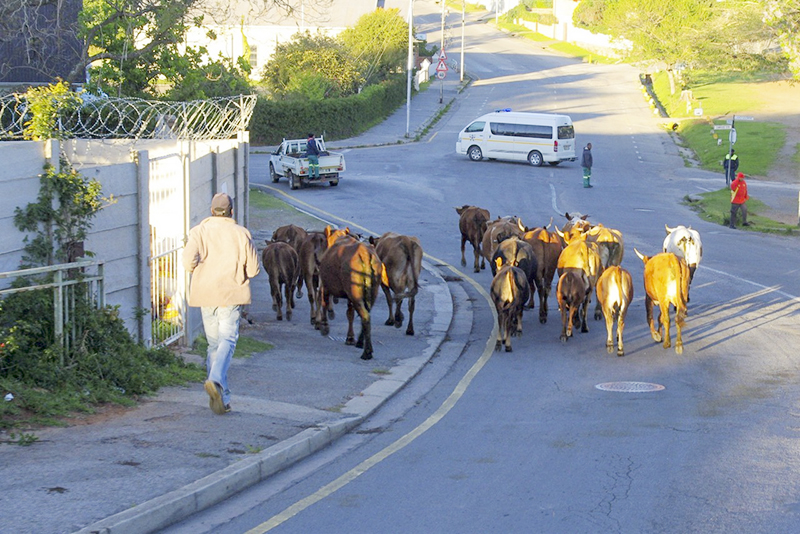
The Makana Business Residents Association (MBRA) has turned to the High Court as a “last resort” to compel Makana Municipality to address the persistent issue of stray livestock roaming urban areas. This follows unsuccessful engagements with officials since January 2025.
In its founding affidavit, the MBRA demands that the Municipal Manager and Executive Mayor submit a report within 30 days detailing steps taken to enforce bylaws on animal control. It also seeks a timeline for establishing a functional animal pound and proper management of municipal commonages and open spaces.
Additionally, the group requests:
- Names of all users of commonages, public open spaces, and municipal farms;
- A full inventory of animals grazing there;
- Records of grazing fees and rentals collected over the past five years;
- Details of veterinary tests on stock, including results from the last five years;
- A report on the condition of boundary fences around these properties.
Background in the affidavit reveals that the municipality’s commonage has grown from 3,370 hectares in the early 2000s to 11,578 hectares today, primarily to support emerging farmers. Its estimated carrying capacity is 1,862 large stock units (a standard measure equating to one cow or five sheep).
Despite assistance from Rhodes University, the Agricultural Research Council, and others since 2005, the affidavit claims no progress, attributing the problem to a small group monopolising the land with alleged municipal consent. It notes that no rental income was recorded for the commonage for at least 10 years.
The affidavit records that at an ordinary council meeting on 30 October 2019, it was made known that the lease agreements with the emerging farmers had lapsed and that the municipality was considering a new kind of lease arrangement with an association rather than individual farmers, which was thought to be more beneficial.
The affidavit points out that the failure to control animal roaming was one of the issues cited in the application to the High Court to dissolve the municipality in 2019.
The document also records numerous letters to and engagements with the municipality this year, attempting to get action on the issue and to avoid legal action. Among them:
- On 13 January, a letter was sent on behalf of the Makana Unity League, the Business Forum and the Residents’ Association to the Municipal Manager and Executive Mayor, urging them to deal with the situation. Although the municipality responded with an “action plan”, the situation did not improve.
- In May this year, the head of Graeme College wrote to the Municipal Manager about an aggressive bull found on a playing field and cattle dung posing a health hazard.
- Then, in June, responding to a report in the Daily Maverick about foot and mouth disease and no improvement in the situation, a letter was sent asking for an urgent meeting, which was held with the Parks and Recreation Department.
- In July, further letters and attempts were made by the municipality to identify land for a pound and to review what the municipality called “the antiquated legislative framework governing animal impoundment”.
The affidavit cites harms like injuries to people and animals, property damage, graveyard desecration, and risks at the airfield and schools. It echoes concerns from a 2019 court bid to dissolve the municipality.
MBRA chair Marcus Mostert called the action a “last resort” after exhausting other remedies, seeking a court-supervised order. The municipality did not respond to requests for comment by publication time. The case could set a precedent for rural-urban livestock management in South Africa, with a hearing date pending.

