





By Gcina Ntsaluba
With Disability Rights Awareness Month ending on Wednesday (3 December), a local social worker is calling attention to the stark realities facing Makhanda’s disabled community, where crumbling infrastructure, absent educational facilities, and economic hardship create daily obstacles.
The Association for Persons with Physical Disabilities (APD) is one lifeline for disabled residents across Makana municipality. Operating with just two staff members, the organisation provides home-based care to clients who often cannot access town due to mobility challenges.
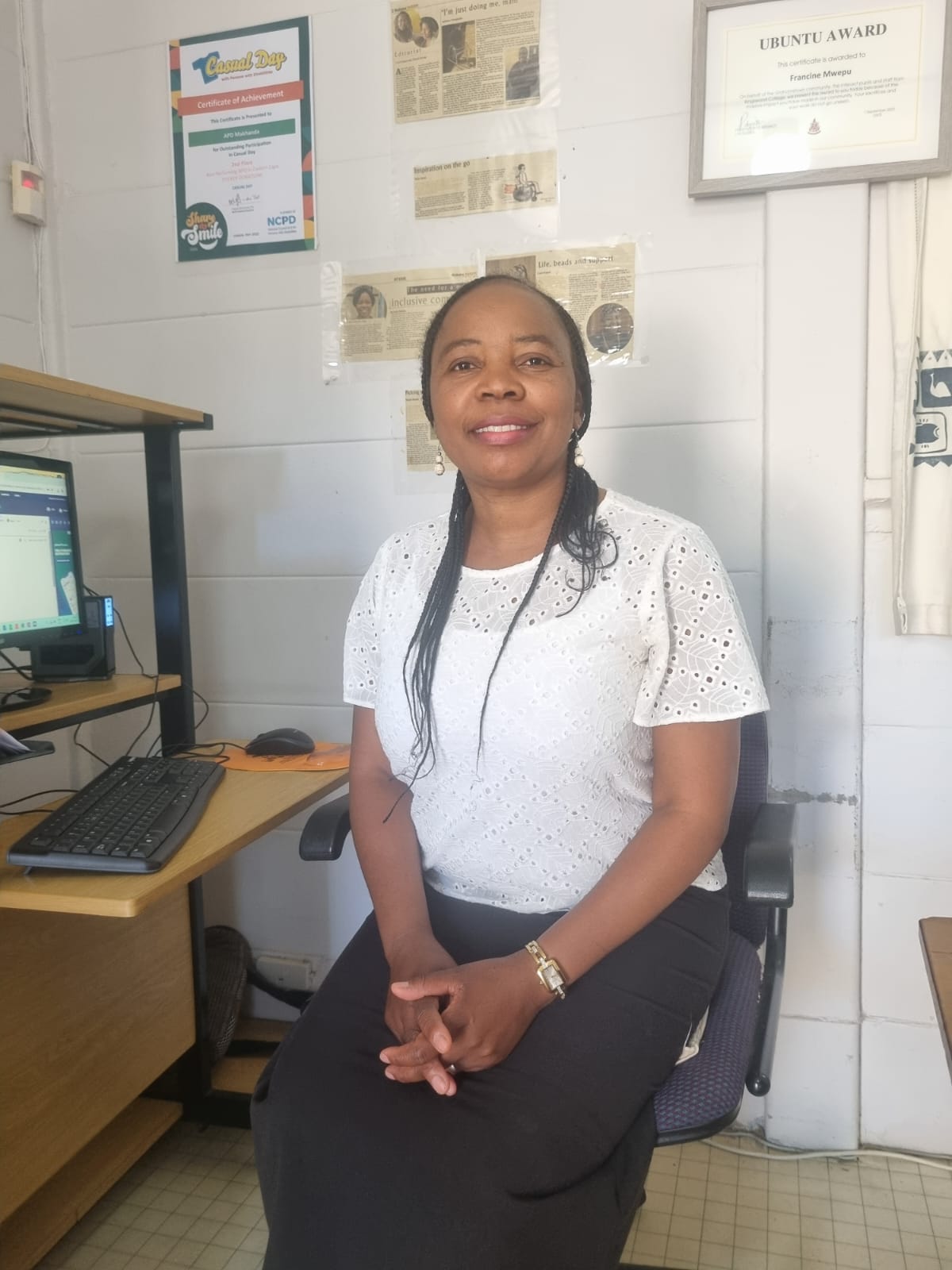
“Most of the time, we visit people because people with disabilities struggle to get to town. We see them at their homes,” explains Francine Mwepu, who has worked as a social worker with APD since 2010.
Transportation and accessibility barriers
Getting around Makhanda presents formidable challenges. Many disabled residents lack wheelchairs or crutches, while those who do have mobility equipment face resistance from taxi operators. “Sometimes they charge them double. Sometimes they don’t want to transport them because they take time to get into a taxi and then to get out of a taxi,” Mwepu said.
Even when wheelchairs are available, Makhanda’s deteriorating roads quickly damage the equipment. Potholes and gravel roads can destroy wheelchairs within months. As Mwepu noted, “The roads are not good, and the wheelchair gets damaged quickly.”
Long waiting periods for replacement wheelchairs exacerbate the problem, leaving residents stranded for lengths of time.
Children left behind
The absence of specialised educational facilities is one of Makhanda’s most pressing failures for its disabled population. Unlike larger South African cities, where daily transport, therapy sessions, and educational activities are standard, Makhanda offers no day centres for children with severe mental, physical, or intellectual disabilities.
Without these services, disabled children remain home with their mothers, missing out on crucial developmental support and leaving caregivers without respite. “Children stay at home with their mothers. It’s a big problem,” Mwepu said.
Economic struggles
In a city where unemployment already runs high among able-bodied residents, employment prospects for disabled adults in Makhanda remain dismal. Many households depend entirely on disability grants of just over R2 000 monthly — often stretched across families of five or six people.
“They sit at home, doing nothing. They only rely on a small disability grant,” Mwepu said. “So it’s difficult.”
This economic vulnerability makes APD’s psychosocial support services crucial. Through their home visits, the organisation provides counselling, encouragement, and connections to resources, taking a holistic approach that considers family environment, education levels, and individual circumstances.
Financial constraints limit services
However, APD operates on a shoestring budget. Government funding covers only staff salaries for Mwepu and an auxiliary social worker, leaving operational costs — such as electricity, internet access, and vehicle fuel for home visits — to be met through fundraising and donations.
The organisation’s main annual fundraiser, Casual Day in September, has not fully recovered from Covid-19’s impact. This year’s event sold 2 000 stickers of the 3 000 ordered, with some revenue lost to retail competition.
Building partnerships
Despite resource limitations, APD has cultivated valuable community partnerships. Kingswood College conducts annual fundraising to purchase wheelchairs for clients, while strong relationships with the Department of Health’s Allied Health Workers ensure physiotherapists, occupational therapists, and audiologists remain accessible.
“Without them, we cannot do our jobs,” Mwepu said. “Whenever there’s a case, we refer to them, and they attend to the clients.”
The organisation also facilitates monthly support group meetings where parents can share concerns and receive guidance from visiting professionals, including physiotherapists and faith leaders.
A call for community action
As Disability Rights Awareness Month approaches its end, Mwepu issued a direct appeal to Makhanda’s residents and businesses. “We need support,” she said. “We need support with regard to finance because we are an NPO.”
She welcomes donations of any kind. Financial contributions, equipment, or other resources that could ease the burden on disabled residents struggling in a city ill-equipped to meet their needs, would all be put to good use.
To learn about donation opportunities, contact APD via Facebook or their office in Cobden Street or on 046 622 5359.

