





By Gcina Ntsaluba
The Democratic Alliance’s (DA) Deputy Minister for Higher Education and Training Dr Mimmy Gondwe has urged young people to embrace educational opportunities beyond traditional universities, emphasising that technical and vocational training can be equally transformative.
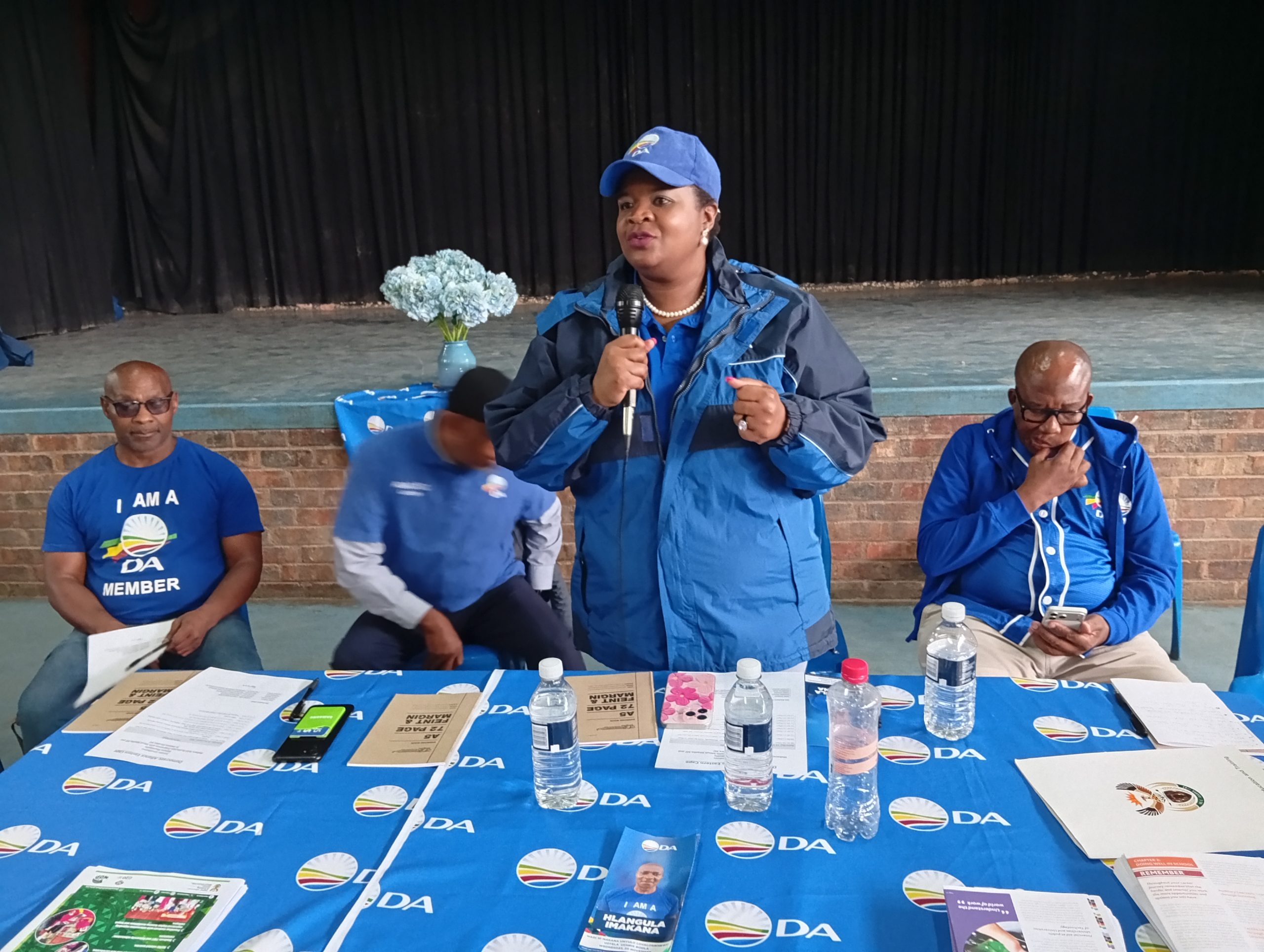
Speaking at a campaign event in Makhanda in support of the DA candidate for the upcoming by-elections in ward 10, Gondwe shared her personal journey through South Africa’s education system and highlighted the critical role of skills development in addressing the country’s unemployment crisis.
“Education opens doors for you that no one else can open,” Gondwe said, “if you see me today, it’s because I worked hard.”
Gondwe, who holds four degrees including a PhD from Stellenbosch University, said she was the first African woman to receive a doctorate from the institution’s law department. But, she said, her perspective on education has broadened since taking office.
“Before I came into this space, I didn’t know much about TVET colleges. I didn’t know much about community colleges,” she admitted. “And like everybody, I thought, if you end up at a university, you’re clever, and you’re going to become somebody. And if you’re at a TVET or a community college, then you are not good enough for the university. But that conception that I had was turned on its head when I came into office.”
Artisans as the future
The deputy minister made a strong case for Technical and Vocational Education and Training (TVET) colleges, which produce artisans in fields such as welding, bricklaying, and carpentry.
“I always say artisans are the future, because a lot of roles and responsibilities will be replaced by AI, because we have these rapid technological advancements,” Gondwe said. “But the work that an artisan does, your bricklayer, your welder, that cannot be replaced by AI.”
South Africa’s higher education sector currently faces significant capacity challenges. Gondwe revealed that at the beginning of this academic year, more than 300 000 young people obtained bachelor’s passes, but only 200 000 university places were available.
“So, we need to see more students going into the TVETs and into the community college sector,” she said.
Community colleges: a second chance
Gondwe also highlighted the role of community colleges in providing educational opportunities for those who may have fallen through the cracks of the formal education system. “That mature lady sitting at home with three kids, wondering, is there time for me to go back and learn something? Yes, you can,” she said.
She noted that community colleges charge no fees and don’t require a matric certificate, offering courses ranging from dressmaking to event planning. “The nice thing about community colleges is that you don’t even need a matric certificate for it. So, you can go in, learn a skill. I’ve even met some mature ladies who are into event planning, planning for weddings, for funerals.”
Entrepreneurship as a solution
Addressing the country’s high unemployment rate, Gondwe emphasised the importance of entrepreneurship and self-employment. “As a country with unemployment, the high level of unemployment, and I always say that our success as a sector is not only just skilling and training, but skilling and training for employability,” she said. “And when I talk about employability, I’m not talking about going to work for someone, but also for self-employment and entrepreneurship.”
The deputy minister called for entrepreneurship to be embedded into higher education curricula as a compulsory component. “The reality is that the economy is not growing as fast as it should be growing. And it’s unlikely, in fact it’s impossible to absorb every unemployed person. That’s why we need to see more young people being entrepreneurs, having their own businesses.”
Focus on women’s education
Gondwe placed particular emphasis on the importance of educating women, noting that they constitute the majority of South Africa’s population. “Research has shown that an educated woman is able to make better choices and better decisions. Educated women are less likely to be victims of gender-based violence.”
She added: “The GNU owes its existence to women.”
Outreach programmes
Gondwe described several initiatives her department is implementing, including a matric support programme, a help desk for higher education queries, and a programme called “Taking higher education to the people” aimed at reaching remote and rural areas.
She also announced plans to return to Makhanda for a higher education and training outreach event at a central location. “I want to be available. I want to be accessible. I want to come back and have a higher education and training outreach at a central point somewhere in Makanda where people then can come and be able to access information on education and training opportunities.”
Gondwe noted that South Africa had approximately 3.8 million young people neither in employment nor training last year, a figure she believes has now reached four million.
She concluded with an encouraging message: “I want to remind you that there’s an opportunity for everyone and where there’s a will, there’s always a way. So, if you really want to get some sort of education, go for it.”

