





REVIEW
Magnitude
By Benevolence Mazhinji
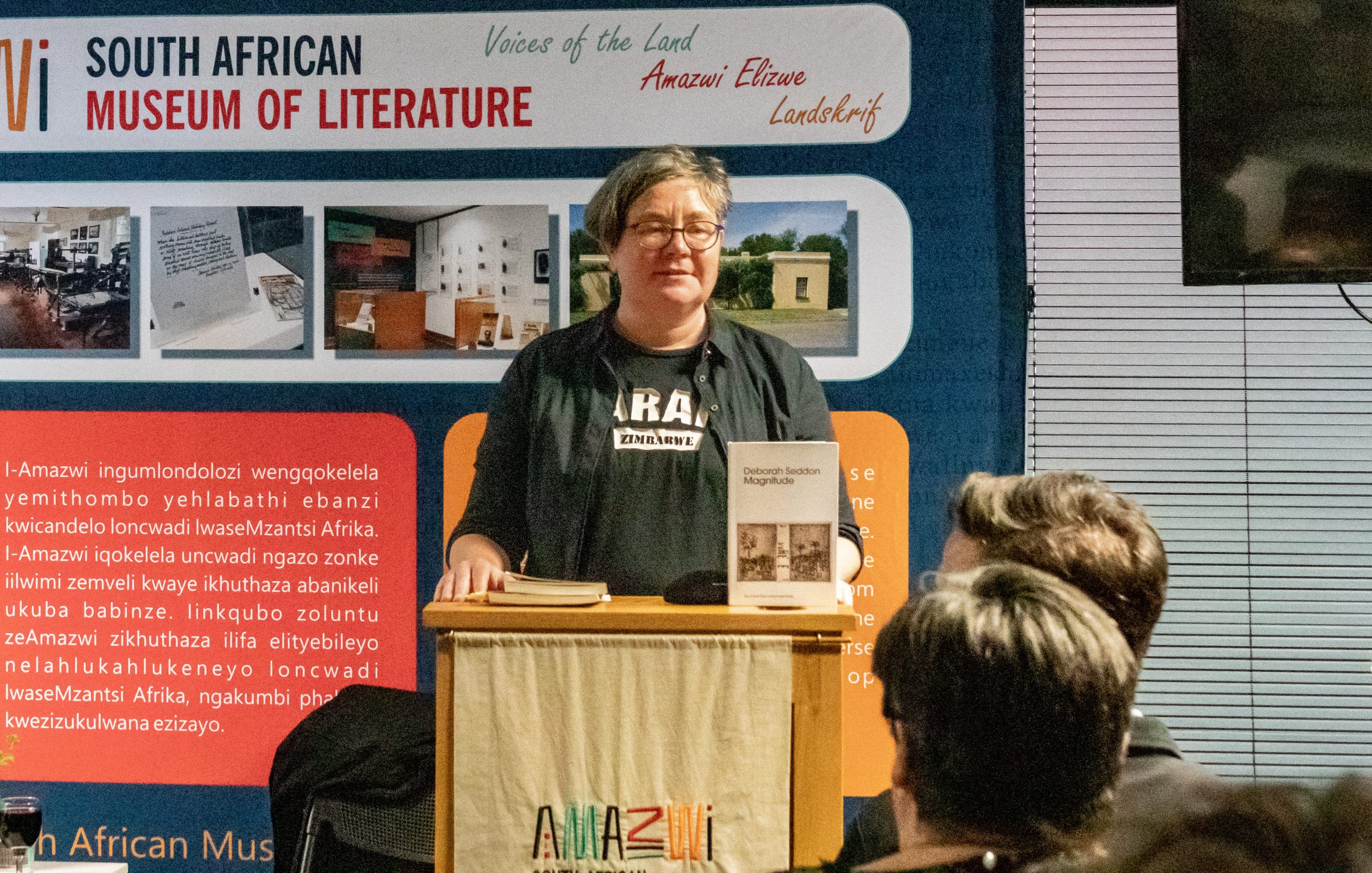
Poet and Rhodes University lecturer Deborah Seddon launched her debut poetry collection, Magnitude, at the Amazwi South African Museum of Literature last week. She was joined in conversation by graphic novelist Nathan Trantraal to trace the contours of her emotionally devastating yet comforting and cathartic poetry.
Seddon’s craft is remarkable in its careful balance of precision and intimacy. Each poem feels both meticulously shaped and effortlessly natural, as if the act of writing itself is a process of discovery, unfolding in real time for both the poet and the reader. She said that after her mother died in 2019, while she was in the process of packing up her childhood home in Harare, she felt that the grief was “quite overwhelming”. She told the packed venue, “I needed to find a way to write myself back into being able to say anything at all.” Writing these poems became an “important means of coping with and processing my devastating loss and grief”.
In the conversation, Trantraal noted how her style functions almost as an act of naming and mapping experience through these finely observed moments. Readers encounter unspoken aspects of their own lives reflected to them in her words. He said, “People don’t know what they’re like until they see themselves presented in a book or see an element of themselves presented in writing.”
This careful attention to detail and the layering of personal and universal experience is evident in the very title of the collection. “Magnitude contains various associations for me in the wake of my mother’s death and other events detailed in these poems,” Seddon said. “In physics, magnitude is a unit of measurement used to specify the size or intensity of an event. For instance, seismic magnitude refers to the measurement of the strength of an earthquake. Stellar magnitude is a measurement of the brightness of stars and other celestial objects. Astronomy and the stars fascinated my mother. The title poem of the collection explores what her lifelong interest taught me about the magic, mystery, and complexity of our life on earth, because everything we know is connected to the wider universe.”
This awareness of how personal experience resonates within a larger web of connections also frames the collection’s exploration of loss in its many forms because, while the poems meditate on the intensity of grief following her mother’s death, they equally trace the emotional weight of displacement and capture the dislocation and longing that came with leaving her home country, Zimbabwe. “Perhaps my first audience is always other Zimbabweans, especially my treasured high school friends, most of whom, like me, now live outside Zimbabwe. We grew up together in a country we loved. We have shared in our adulthood a similar experience of loving and losing this country, where most of our parents continued to live.”
Her favourite poem in the collection is called Reggae for Bob. It is dedicated to a beloved school friend, Gillian Makura, who died in 2015, and the poem depicts a beautiful day shared with her school friends in the Harare Botanical Gardens. Seddon called it “a meditation on finding and making a new way of being, as a new, multiracial generation quite different from our parents’ generation, after a terrible civil war”. The poem captures the intimacy of shared experience, the joys and losses of youth, and the delicate traces of memory that linger long after those days have passed. At the same time, these reflections extend naturally into her present life in South Africa, where her poetry continues to explore identity.
Seddon describes her feelings about living in South Africa as complex. “I’m just as committed to South Africa. I think this country is a miracle. It really is. We have to be more grateful. There’s a lot which needs to be sorted out. But there is the opportunity for a viable democracy, a free press, people being able to say whatever they think.” She was very honest in saying that, as much as she misses Zimbabwe, she wouldn’t be able to be an academic there. “I wouldn’t be able to be a poet there. I wouldn’t be able to say the kind of things that I can say as a teacher in my classrooms here.”
Her work forms part of the important responsibility that writers have to build a linguistic architecture where others can experience emotions they find indescribable . Seddon has been writing poetry since she was a small child. “It is part of who I am, and it is a fundamental way for me to make sense of the world around me,” she said. “I hope that my sense-making activity can make sense to other people, too. I want as a poet to communicate something deeply felt, something true, and something that has both personal and political resonance.”
Magnitude is published by Dryad Press in its Living Poets Series.

