





By Fahdia Msaka, Luyolo Sithole and Yanganani Gora
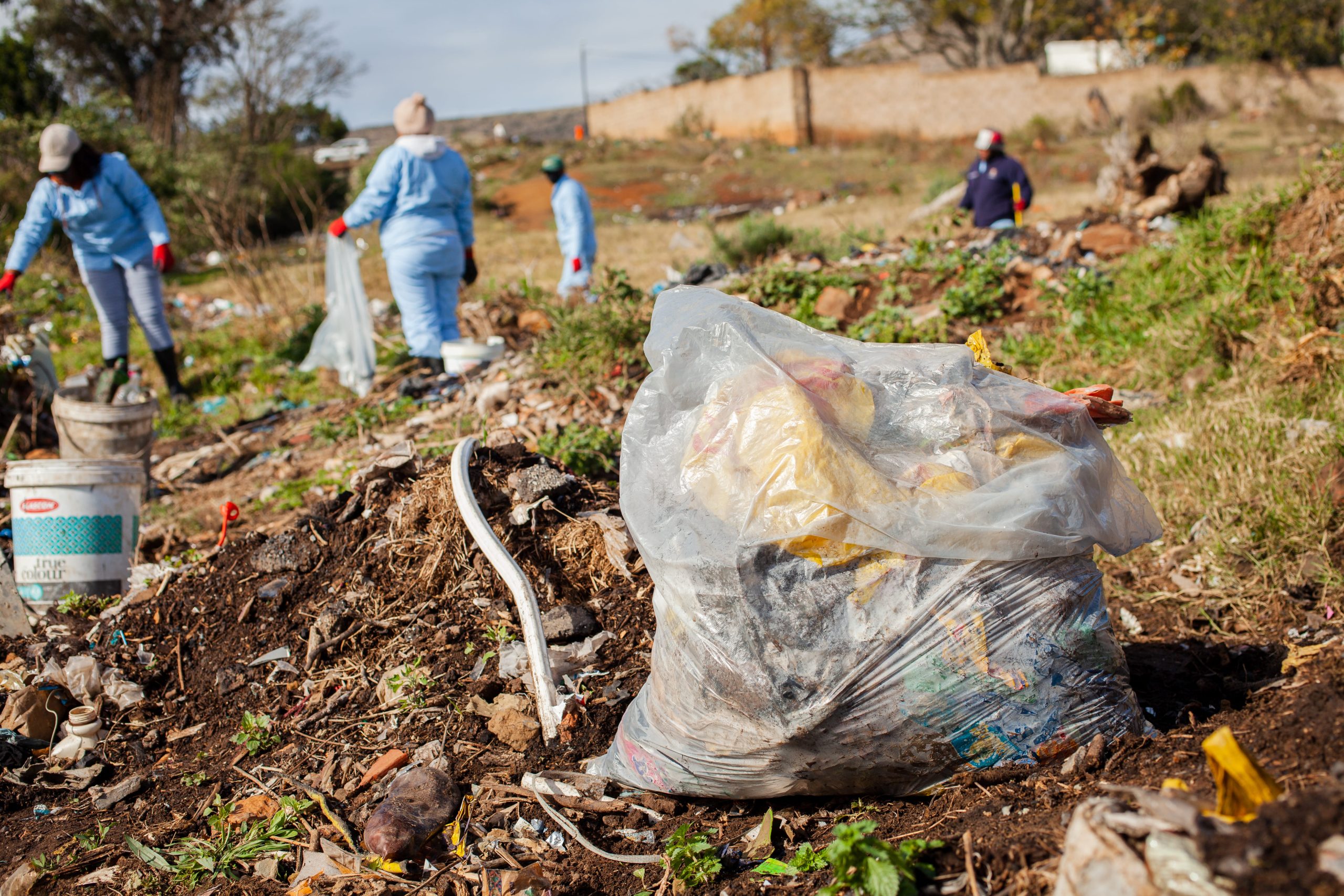
Climbing over rotting heaps of trash, exposed to sharp objects, metal, broken glass, toxic fumes, and disease, waste pickers in Makhanda make a living by separating plastics from metals, glass from food waste and other discarded materials using nothing but their five senses. Among them is a young girl who claims she is 18 but looks barely 16. Her eyes tell a story that she was not comfortable sharing, a story that seemed to weigh heavily on her. She works alone alongside men, alone, with other and even younger boys.
In Makhanda, waste pickers are a familiar presence around dumpsites, landfills, and streets, marked by their survival tools: trolleys, sacks, and gloves. Yet, as waste picker Thembani Mfondini explains, municipal neglect has turned Makhanda’s landfill into a dangerous place for the men, women, and even children who work there. Instead of being divided into managed sections to limit environmental damage and protect workers, the site is a chaotic sprawl where piles of rotting waste bleed into one another. According to Mfondini and fellow waste picker Thembani Fagyi, shocking discoveries are common, including discarded babies, used needles, and condoms. Accidents are frequent and often severe; Mfondini recalled a man they knew who had his head crushed by a truck.
By contrast, the Social Employment Fund (SEF) project run by Hilton Haakonsen has set out to turn Makhanda’s trash into jobs and products by creating safe, working opportunities for waste pickers and others driven to go through trash for anything reusable. By turning plastics into pavers, refuse into compost, and unemployed residents into skilled workers, the project has built a model of social employment that uplifts communities while healing the environment.
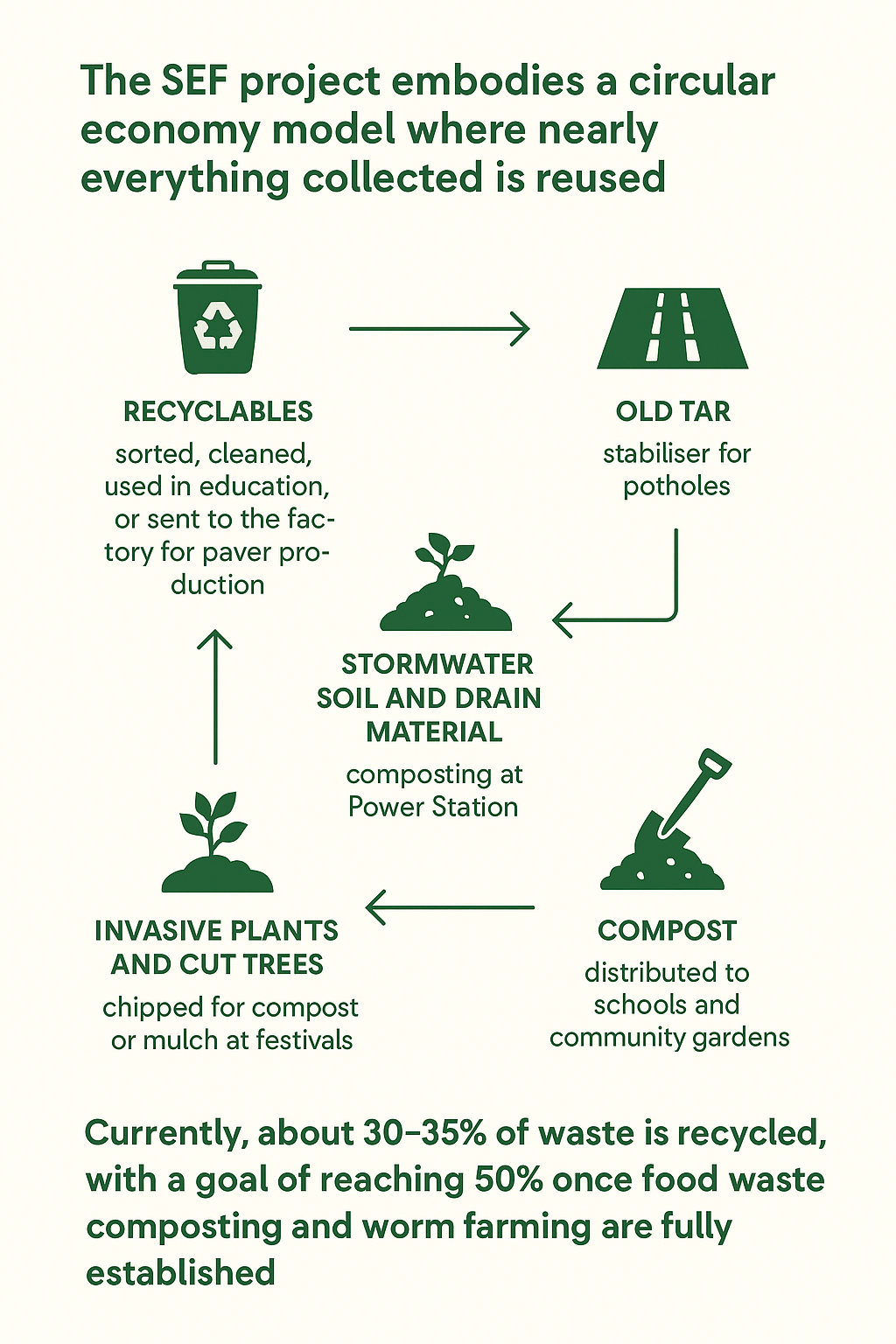
The SEF project works with a circular model so that all the trash they find can be used in productive ways to benefit the environment.

The SEF project works under a memorandum of understanding with the municipality. According to Hansoek, while collaboration with leadership, the municipal manager, mayor, and CFO, has been strong, co-operation with ground-level workers has been inconsistent. Some departments, such as Parks and Waste, coordinate well with SEF, while others, like Roads, have been resistant.
In 2023–2024, when the bankrupt municipality could not supply tar for a year, SEF relied on donations, including over R500 000 worth of tar from a local wind farm. Despite these challenges, the project continues to fill critical gaps in municipal service delivery.
Launched in June 2022, the SEF project operates under the Presidential Employment Stimulus Fund (PESP), a national initiative supporting arts, culture, conservation, and social development. Haakonsen said the National Arts Festival was concerned about Makhanda’s deteriorating infrastructure, which threatened to discourage visitors and impact local businesses, and so submitted the proposal, leading to the project’s official launch with 26 participants. By August 2022, it had expanded to nearly 2,000 workers across the city.
The start of the SEF project taught the organisers that paper application forms were difficult to manage because of the huge number of applications (7,000 people applied for 1,500 places). They then introduced formal contracts, biometric attendance, and better safety measures. The project then upscaled to work across recycling, roads, schools, factories, and circular economy initiatives, supporting around 2,000 participants.
Since then, the project has also involved paving, composting, and biochar projects backed by formal funding proposals. The SEF project has already applied for the next phase and is awaiting a response. One of the issues to address is transport for workers and the need for their own vehicles.
SEF specialised units
The SEF project operates through a series of specialised units, each focused on a specific community, environmental, or infrastructural initiative. This way, the goals of environmental management and community development are coordinated with infrastructure and skills training.
| Unit / Focus Area | Leaders / Key Personnel | Activities / Responsibilities |
| Plastics & Waste Collection | Ruben Aries, Asakhe Faxa | Collecting and managing waste materials.
Overseeing and managing the cleaning of schools and planting and maintenance of the feeding scheme’s vegetable gardens. |
| Makana Revive | Given Faxa
Elizabeth Davies |
Cleaning and clearing illegal dumping sites and rehabilitation of the same, as well as waste collection, sorting, and community education. |
| Recycling | Michelle Lowry | Sorting and cleaning recyclables
Training and workshops for SEF staff and school and University learners. |
| Factory | Khanya Lombo and Leon Coetzee | Maintaining and repairing schools( painting, plumbing, electrical, masonry) and general school cleaning (classes, offices and grounds. |
| Power Station | Tim Cooper, Dr Tracey Nowell and Melissa Fourie. | Research and nursery for aloes, indigenous plants and trees, vegetable production and testing of varieties and cross breeding, compost making from waste materials and stormwater and drain material, wood chipping and general maintenance. Aquaponics and waterbed vegetable production. |
| Invasive Vegetation Clearing | Tim Cooper and James Ashlyltai | Removal of alien plants, trees, and riverline vegetation. Using materials in the production of chips and compost. |
| Roads & Pothole Repairs | Alfred Gwe ( now a consultant) | Repairing roads and potholes. Clearing of stormwater drains and roadside drains. |
| Umthathi Training Centre | Andiswa September, Mtobeli Mali, Wongalethu, and Pumeza Ndingi | Production of vegetable seedlings for the various sites and the Umthathi vegetable garden (5ha plot). Training in nutrition, permaculture, and indigenous ointment making. Establishing and maintaining vegetable gardens in schools and clinics, especially in the Joza area. |
| Monument Admin | Sandiswa Ngete,
Vuyolwethu Mandlana and Various other staff |
All admin work, including contracts, payroll, wage queries, management and team leader meetings, correspondence and Festival staff control and placements. End of contract notifications, letters of service, UI19 issues and all general admin queries. |
| School | Leon Coetzee | Maintaining and repairing schools( painting, plumbing, electrical, masonry) and general school cleaning (classes, offices and grounds. |
The SEF nationally is managed by the Industrial Development Corporation (IDC) to combat unemployment by turning community-driven projects into meaningful work opportunities. Working with partners in health, caregiving, digital inclusion, education, the environment, and the arts, 1,100 community organisations are supported by this fund. This has created jobs, built skills, empowered individuals, and had a lasting social and economic impact. Approximately 80% of its budget goes directly to wages. In Makhanda, every worker is provided with personal protective equipment (PPE) such as safety boots, gloves, and overalls. The SEF project spends around R1.5 million per phase on work tools and PPE.
SEF impact in Makhanda
The SEF’s most visible operation is its waste collection and recycling system. Between 40,000 and 60,000 refuse bags are distributed and collected monthly, with red bags marking SEF’s contribution. Collection is supported by five rented vehicles, including trailers, bakkies, and trucks. Pickers sort waste, and recyclables are cleaned and prepared by Michelle Lowry’s team.
Lowry and Obusitswe Seage work together to head up the recycling team, blending their artistic passion with environmental work. The two met in Johannesburg, where Lowry hosted artists in her home to give them a space to pursue their dreams. After the COVID pandemic, she moved to Makhanda, where she became involved with NAF. Asked to lead the recycling team, Lowry reached out to Seage, knowing she could not manage such a large project alone.
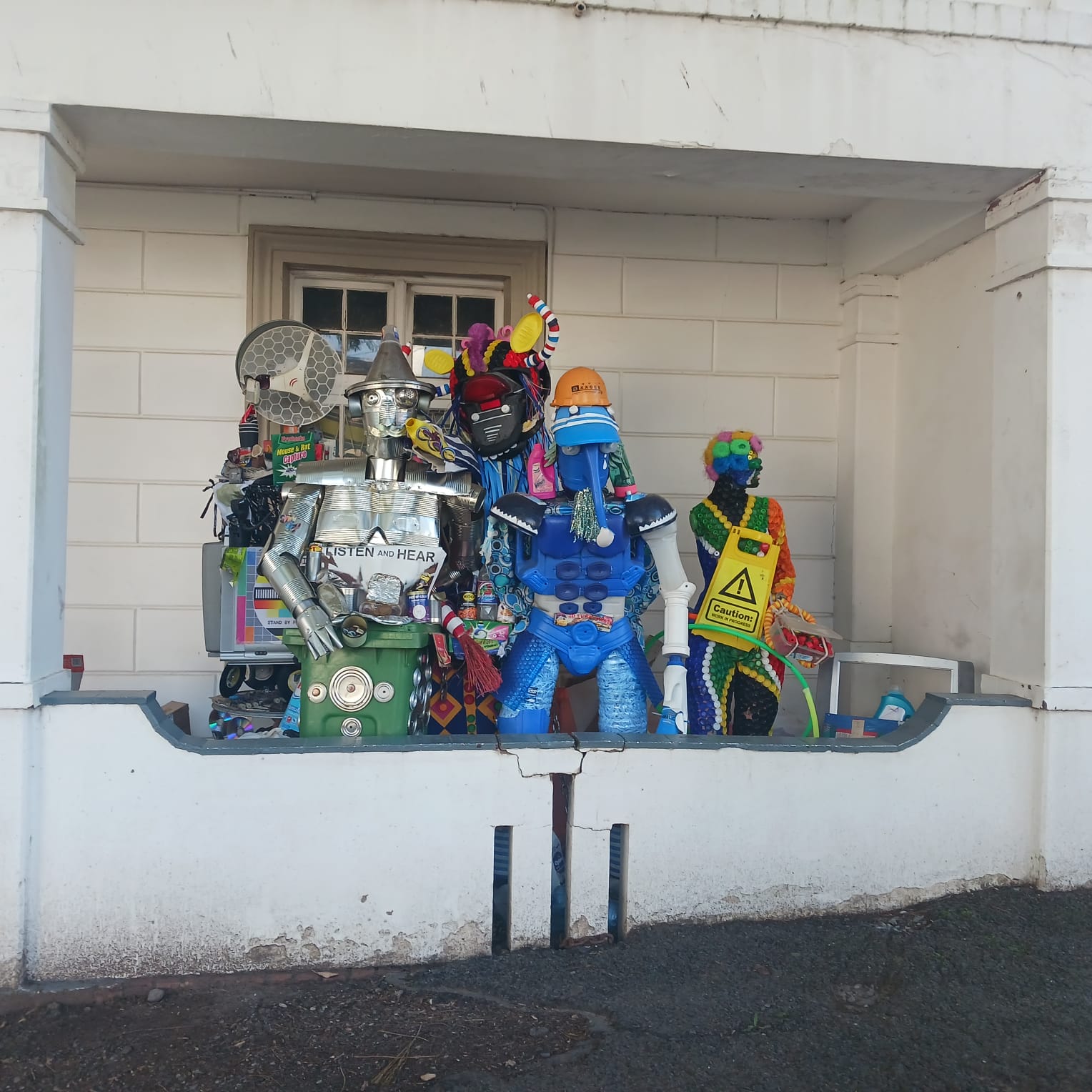
They channelled their creativity into making art from discarded materials. This gave rise to the Purch Garbogoyles, large statues and toys built from trash, inspired by an ’80s and ’90s cartoon but reimagined with an African edge. They have since travelled with these creations, performing plays about how careless waste disposal damages the earth. Their goal is to take the Garbogoyles to schools, showing children that imagination has no limits. They repurpose waste into toys, such as a fish made from a used Jik bottle and counting tools made from lids to teach children.

The SEF factory produces pavers from recycled glass, plastics, and cement. Recycling brick pavers involves collecting old or broken pavers, crushing them into small aggregate, and mixing the material with clay, water, or other binders to produce new bricks or paving products. After a year of prototyping, the team has developed a market-ready product and now produces about 1,000 pavers a week, with potential for 100,000 a week.
Roadwork teams repair potholes and resurface roads across Makhanda using old tar as a stabiliser in a closed-loop system.
The Power Station site serves as a research and agricultural hub. Botanists and team members study indigenous plants and maintain nurseries and vegetable gardens. Composting operations convert organic waste and invasive plants into fertiliser used in 27 school gardens and five clinics.
Plans include biochar production and expanding food composting plants and worm farms to further reduce landfill waste.
Schools and community support
The schools team provides maintenance and infrastructure support, with masons, electricians, and plumbers addressing urgent needs. Vegetable gardens contribute to school feeding schemes. The project also partners with communities to rehabilitate dumping sites, planting indigenous aloes to discourage illegal dumping and foster local pride.
One of the close relationships SEF has built with the Makhanda community is reflected in the partnership between Lowry’s team and Zwelinzima Somayali, caretaker of Luvuyo Hall. The hall in Fingo Village on Old Cemetery Road has been abandoned by the municipality since 2017. Somayali, one of the hall’s founding members, has taken it upon himself to protect the space from further neglect, discouraging vandalism and illegal use.
Despite his efforts, the hall has faced repeated challenges, including fires, vandalism, littering, and graffiti. In a joint effort to reclaim the space, Lowry and Somayali agreed to use the hall as the main base for SEF’s recycling team. Together, they have also established aloe vera plants and vegetable gardens around the hall to deter pollution and dumping in the area, an initiative that has already shown positive results.
SEF’s next steps
SEF is partnering with Rhodes University to establish recycling stations for glass, plastics, cardboard, and paper. They also plan to involve Pick n Pay, Checkers and Shoprite.
While challenges remain, such as livestock destroying gardens and illegal dumping, the project has demonstrated the potential of combining employment creation with sustainable development. By building on its model of waste recovery, road repair, and community engagement, SEF aims to deepen its impact in the next phase and beyond.

