


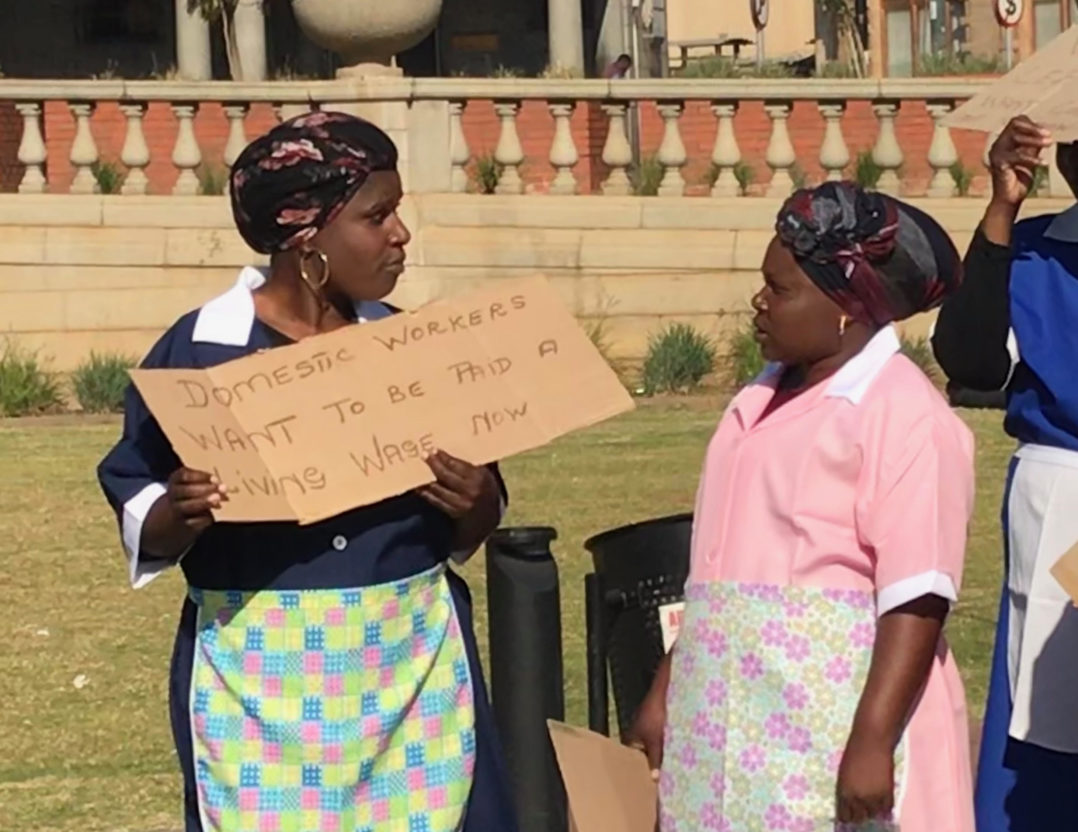
The One Wage Campaign – a coalition of workers’ rights organisations, unions and civil society
members, with the support of Lawyers for Human Rights – formally lodged a legal submission to the
National Minimum Wage (NMW) Commission on 20 November 2019, arguing against the exclusion
of domestic, farm, and EPWP workers from the full national minimum wage.
The NMW Act came into effect in South Africa on 1 January 2020. While the legislation sets a full
minimum wage of R20.00 per hour for most workers, farmworkers are entitled to 90% of the NMW
(R18.00 per hour), domestic workers to 75% (R15.00 per hour), and workers in the Expanded Public
Works Programme (EPWP) have the right to only 60% of the minimum wage (R11.00 per hour).
Although the Act allows for the possibility of phasing in domestic and farmworkers to earn 100% of
the minimum wage by the end of 2020, it does not require it, nor does it make such a provision for
EPWP workers.
The Commission is obliged by the end of 2019, a few short weeks away, to make recommendations
to the Minister of Employment and Labour about adjustments to the NMW. The One Wage
Campaign (OWC) submits that the 2020 adjustments must recognise all workers as equal under the
law, and that ultimately the minimum wage must be increased to a living wage.
The One Wage Campaign is urging the public to sign a petition endorsing equality of all workers
under the National Minimum Wage. You can sign the One Wage Campaign petition at
www.onewage.org or www.facebook.com/OneWage/
The stated purpose of the NMW Act is “to advance economic development and social justice” by,
among other things, improving the wages of lowest paid workers. According to the OWC Submission,
over 95% of domestic workers, and nearly 90% of farmworkers, are earning below the poverty line
of R4 125.00 for a household, comprising the largest sector of South Africa’s working poor. Yet,
these are the very workers excluded from the NMW.
The endurance of such a system cannot survive scrutiny under the Constitution. It breaches the
rights to equality, dignity and fair labour practices and perpetuates the existence of sub-classes,
members of whom have been historically discriminated against and whose work is treated as less
worthy than that of others.
The International Labour Organisation (ILO) also does not recommend tiering minimum wages (or
excluding certain sectors from the wage). It creates a fragmented system that is harder to enforce
and discriminates against low-wage workers, which are disproportionately women.
The Pietermaritzburg Economic Justice & Dignity Group’s latest Household Affordability Index states
that if a worker were to cover the three core goods and services of transport, electricity and
a basic nutritional food basket in November 2019, then the NMW would have to be increased to
R24.65 an hour with workers engaged in their jobs for the maximum working-day month. However,
even this increase is inadequate as families have much more expenses than these to cover such as
rent, toiletries and school fees, etc. If the full minimum wage of R20.00 an hour isn’t enough to even
cover these three core costs, what about those who are earning even less?
In addition to a legal analysis of the unconstitutionality of tiered wages, and a report of the potential
impact on employment and the economy, the OWC Submission includes narratives on the lived
experiences of domestic, farm and EPWP workers living on sub-minimum wages.
Lindi Masela, a domestic worker in Johannesburg, wrote: “The minimum wage makes me feel like a
useless parent because there is nothing that I can afford as the money is mainly for food and my
kids’ transport. It is not even enough for buying clothes. We can’t eat healthy.”
A farmworker from the Western Cape wrote: “It is shocking me that this decision was made, that we
as farm workers are seen as a class to earn less than others. When you buy electricity, you are not
asked which class of workers we are. We all have to pay the same.”
Many workers rely on mashonisa (loan sharks) to cover basic living costs, and so stay trapped in debt
trying to make ends meet. Intergenerational poverty is entrenched because they are powerless to
give their kids a better education. As a domestic worker put it: “We followed our mothers here to
come and clean, now our kids are also following us.”
The EPWP scheme was established by the government to provide poverty relief through short-term
community work opportunities. However, the scheme has been criticised for creating a two-tier
labour system and a pool of casual, insecure cheap labour in the public sector. As many EPWP
workers are doing the exact same work as permanent workers, and their “temporary” contracts are
often renewed for years on end, it is a disgrace that they have been excluded from the NMW.
While some have argued that NMW parity will lead to job losses, the OWC economic report
illustrates that there is no conclusive evidence for this, while there is considerable evidence that
increasing minimum wages has a significant positive impact on alleviating poverty and inequality,
with the possibility of a demand stimulus in the economy.
For more on the One Wage Campaign, visit: www.onewage.org
Read the OWC Submission to the NMW Commission here: www.onewage.org/nmw-submission
To determine if you are paying your domestic worker a living wage, visit: living-wage.co.za
