By Asemahle Vumsindo and Donne-Leigh Pienaar
Reports from students who reached out to Grocott’s Mail about being charged consultation fees have triggered an investigation, revealing that Settlers Hospital uses a tiered pricing structure based on an interpretation of the official Uniform Patient Fee Schedule (UPFS) mandated by the Eastern Cape Department of Health.
This specific application of the policy means a student’s access to affordable healthcare is currently determined by their financial aid status, which the hospital uses as a proxy for income assessment rather than a proper, individual evaluation of their actual financial means.
Hospital confirms grant-based tiered charging
In a formal response to the initial enquiry, Settlers Hospital CEO, Zama Mve, confirmed the two-tiered charging system for university students. Mve said: “As Rhodes students you are classified as H3 patients. However, if you’re receiving the national student grant [NSFAS], you may be reclassified to H1 with proof from your bursar.”
The hospital says that foreign students are required to pay the full, unsubsidised rate. While Mve’s statement specifically mentioned Rhodes University students, the policy is based on national UPFS guidelines and applies to all students seeking care at the facility.
UPFS mandates income, not financial aid status
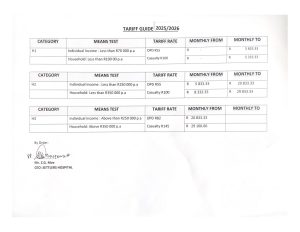
A review of the official UPFS documentation and its means test reveals a discrepancy in this application. The national tariff guidelines define the categories intended to protect the most financially vulnerable based on income, not financial aid:
H1 Patients: Defined as individuals earning less than R70 000 per annum (or household income less than R100 000). For these patients, the Outpatient Department rate is R55 and the Casualty Department rate is R100. Outpatient services refer to scheduled consultations and treatments that do not require hospital admission, while Casualty (or emergency) services handle urgent and emergency medical cases.
H3 Patients (self-funded): Defined as individuals earning above R250 000 per annum (or household income above R350 000). These are the “full paying” patients who pay R82 for Outpatient Department services and R145 for Casualty Department services.
Policy misapplication penalises low-income persons
The hospital’s policy bypasses the official income thresholds by using NSFAS or SASSA grant status as a proxy for income classification. This means that individuals who do not receive the grant, including students from low-income households who may not qualify for NSFAS for various reasons, as well as young workers or unemployed residents in Makana, are automatically classified as high-income H3 patients. The H3 category is legally reserved for individuals earning over R250 000 per year.
Additionally, while the national policy states H1 patients qualify for largely free services, Settlers Hospital still imposes fees of R55 and R100, suggesting a localised interpretation that deviates from the intended provision of free care to the lowest-earning citizens.
The Eastern Cape Department of Health did not respond to questions by the time of publication.