


By Gcina Ntsaluba
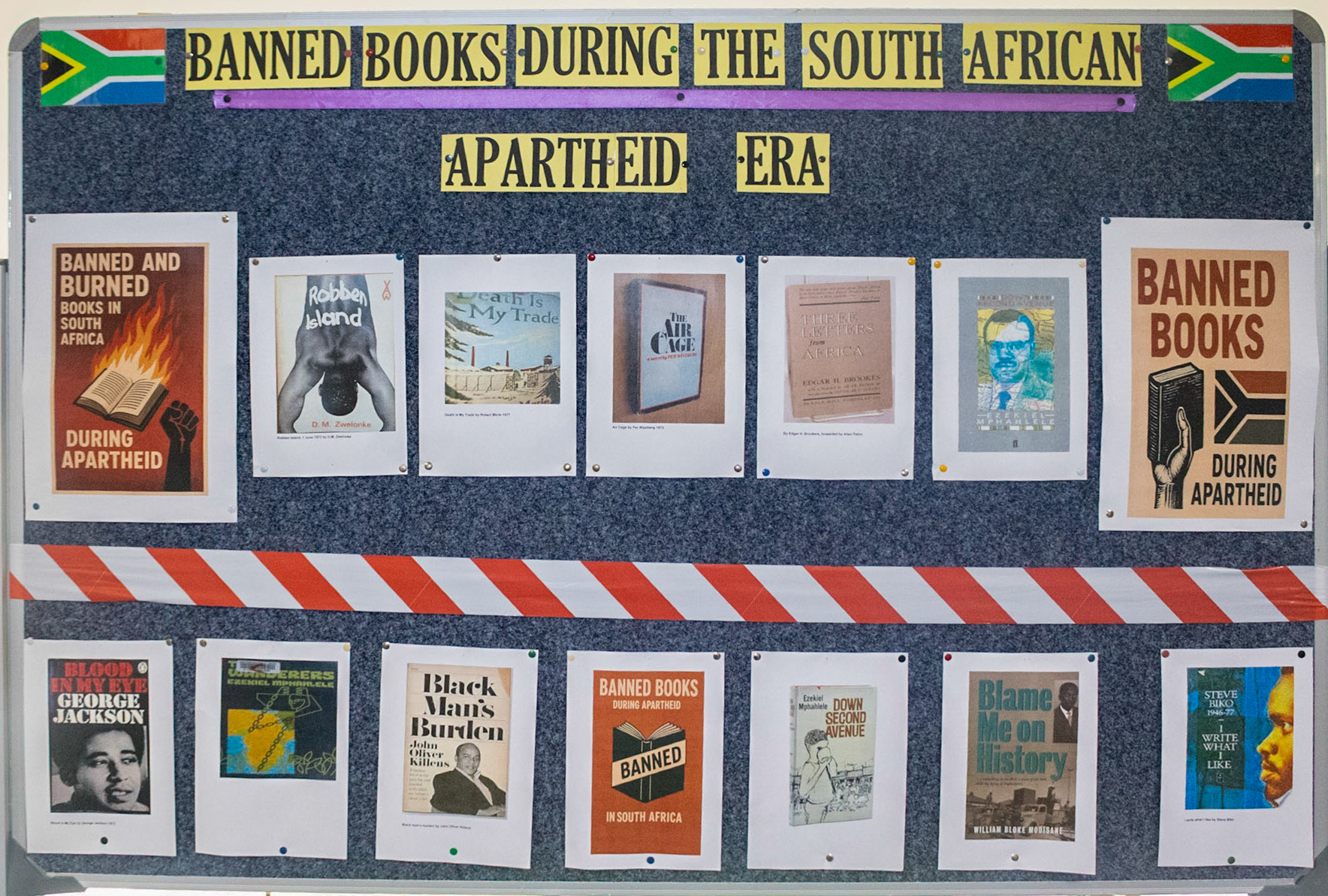
Books that were banned during South Africa’s apartheid era are now on display at Rhodes University Main Library, offering students and the public a glimpse into one of the darkest chapters of the country’s censorship history.
According to Wynand van der Walt, senior manager for innovation, systems and collections at the
university’s library, the exhibition represents a small portion of the more than 26 000 titles listed in Jacobsen’s Index of Objectionable Literature, a comprehensive catalogue of materials the apartheid state sought to suppress.
“These books were banned not for lacking literary merit, but for being perceived as threats to the state,” explained Van der Walt, who worked at the Transvaal Provincial Library Services during the transition to democracy, He said that the censorship apparatus was maintained through an interlocking web of legislation, primarily the Customs Act of 1955 and the Publications Act of 1974, which gave authorities sweeping powers to declare publications “undesirable”.
The banned collection included political writings by African National Congress leaders, works by prominent South African authors such as Alex la Guma, Bessie Head, and André Brink, as well as international classics like George Orwell’s Animal Farm and Nineteen Eighty-Four.
A gradual return
Van der Walt said that the return of these books was a gradual process rather than a single event. While the government of F.W. de Klerk unbanned political organisations like the ANC on 2 February 1990, the formal Publications Act remained in force until the transition to democracy.
“The legal right to possess these books existed almost immediately after the repeal of the old laws, but their presence in libraries and bookstores was not instantaneous,” he said. The full process of reintegration extended throughout the late 1990s and into the 2000s.
Many academic libraries, including Rhodes University, had maintained closed collections where banned books were held with restricted access, often requiring special permission for research purposes. Once the laws changed, these materials were released onto open shelves.
Some lost forever
Van der Walt said that some books proved difficult to find even after being unbanned, with certain editions and original manuscripts lost forever due to systematic destruction during the apartheid years.
“Even today, original printings or specific ephemeral materials from the ban period remain extremely rare and are highly prized by collectors and archives,” he said.
The library continues actively sourcing materials, recently acquiring a copy of Stanley Bekker en die boikot by John Miles which, in 1981, was the first Afrikaans children’s book to be banned. It is now housed at the Cory Library for Humanities Research.
Timely reminder
Van der Walt’s engagement with the exhibition was prompted by Advocate Shuaib Rahim from the Faculty of Law, who reminded him of this period in South African history. The timing coincided with International Banned Books Week (5-11 October 2025), promoted by the American Library Association and Amnesty International.
“The international political landscape keeps reminding me that we should never take our rights for granted,” Van der Walt said, noting that censorship is not limited to authoritarian regimes. During 2024-2025, more than 6 870 instances of book banning have occurred across 23 states in the United States.
Why ideas are dangerous
Reflecting on why the apartheid regime found these books so threatening, Van der Walt explained: “Ideas are dangerous to authoritarian regimes because they possess the capacity to inform and sway support. These alternative ideas unify, motivate, and legitimise resistance, directly challenging the regime’s control over the public mind.”
He emphasised the importance of students and researchers understanding this history: “Intellectual curiosity and the pursuit of diverse knowledge are not merely academic exercises but essential acts of citizenship that protect democracy.”
Van der Walt said that adequate representation of suppressed voices requires systematic curriculum revision, dedicated funding for preservation and digitisation, and active enforcement of constitutional rights to freedom of expression and access to information.
The exhibition serves as both a historical record and a contemporary warning that intellectual freedom must be constantly defended.
